Tuffahiyya (Meat with Apples)

I had a lot of apples on hand when contemplating the next set of dishes to cook.  This recipe (both of them) had been on my list to do.  This is a very simple dish that just requires having everything on hand…like apples, meat and spices.

One note,  I did change the “Intensly sour apples” to firm sweet apples i.e. honeycrisps or pink ladies.  Both of these apples keep their shape and wonderful flavor during and after cooking.

Tuffahiyya

Meat with Apples

Translation:

1st translation – According to another recipe, not the one given earlier.  Fry meat, after boiling it, in melted fat with spices.  Then take strongly sour apples and peel them and take out their seeds, and cut them up medium.  Then throw the apples in the pot or the frying pan, after taking it up, for a good while.  And when they soften and it is done.  It is left on a quiet fire and it is taken up.

(Perry, pp. 352)

2nd translation – Put meat into the pot.  Peel apples and cut them up and put them in it.  Then sweeten it. (…similarly to Safarjaliyya)

(Perry, pp. 471)

Ingredients:

2 lbs cubed stew meat  (beef, venison, goat etc)

4 medium apples, peeled, cored and cut into 1” cubes (sweet or sour)

1 tsp ea of ground: thyme, cumin, coriander, pepper, cinnamon, ginger, saffron, tumeric

1 Tbs. sesame oil

***optional: 1 tsp honey per serving

My redaction:

I cut up stew meat into manageable bite sized pieces, laid out the spices to be used, and the apple chunks.

spices

I have held the theory that meals that were eaten with bread or hands did not have the luxury/opportunity for the eater to take a piece of meat, cut it up then eat.  What was taken was probably eaten and a conversation could not be had over a meal if the participants could not talk while chewing manageable cubes of meat.  That’s just  my theory though and why I cut up stew meat into bite sized pieces.

The cubed beef was placed in a pot of water (just enough to come to the top edge of the meat) and cooked thoroughly for about 20 minutes.

meat in pot

The water will cook down as will the meat.  However the 20 – 30 minutes of cooking makes the meat tender and less chewy.  Many of the recipes would normally say to skim off the foam however this recipe is unique in not mentioning skimming at all.

Once the beef has been cooked, any excess juice was drained off  before placing the cubed cooked meat into a medium pan with the sesame oil.  Spices are then added.

meat with spices

1 tsp of spices for 2lbs of meat may sound like a lot; however we are also cooking the meat and apples, so don’t be afraid that the spices are going to over power the meat.  Everything blends very well together once the apples have been added.

After the spices have been stirred into the meat, the apple slices are added.

meat apples

Everything is mixed well, with the spices coating the meat and apples evenly and allowed to cook till the apples are soft.  Roughly 15 minutes.  I did add a 1/2 a cup of water after the meat and apples had absorbed the sesame oil, then covered the pan to allow the resulting steam to help cook the apples.

meat in bowl

After the apples have soften, the meat and apples are served in a bowl.  Honey can be added  to sweeten the flavor if desired.  I like the flavor with out the honey; the honey adds just a touch of sweetness that compliments the apples with the spices very well.  The honey is up to the personal taste on whether to have a sweet or savory dish.

Glires

Glires

Stuffed Dormice

It’s that time again, when the craving for tasty tasty piggy comes about.  So we return to our old hunting ground of recipes by the Romans for insperation.   This tasty tidbit came about by accident.  I was looking to do a very period recipe called Glires ( Stuffed Dormice).  The original Dormice are cute fluffy tailed small rodents that fit into the palm of a hand.  Dormice were raised by the Romans on large farms (called Glirarii) in great quantity, like chicken and rabbits, with the fattest of dormice being in the most demand.  They were such a popular dish that the consul Marcu Aemilius Scaurus issued a sumptuary law that attempted to prohibit the consumption of dormice, but the law was ineffective due to the popularity of these tasty morsals. (Herklotz, pg 75)  When I tried to get actual Dormice for this recipe there was a monkey pox going on (No, I didn’t make this part up!) and had to substitute some thing else.   At the original making of the recipe, I had a pork loin on hand and decided to use 1″ cuts to act as the “Dormice” body while keeping to the pork filling.   Here is my take on an old time favorite by the Romans with tasty tasty piggy.

Translation:

1). Doormice: Stuff dormice with a pork filling and with the meat of whole dormice ground with pepper, pine nuts, silphium, and garum.  Sew up, place on a baking tile, and put them in the oven; or cook the stuffed (dormice) in a pan. (Herkotz, pg. 75)

*Silphium: the Greek name for laser; a plant of the genus Ferula, now extinct.  Garlic juice is used as a substitute. (or crushed garlic)

2). Stuff the dormice with minced pork, the minced meat of the whole dormice, pounded with pepper, pin-kernels, asafetida, and liquamen,.  Sew up, and place on a tile, put in the oven or cook, stuffed, in a small oven. (Flower, pg. 205)

Ingredients:

3 – 1 1/2” pork rounds                    1/2 cup ground pork  (plain pork meat)

¼ cup pine-nuts                               1 tsp pepper

1 tsp fish sauce                                1 tsp crushed garlic

1 tsp thyme (optional)

My Redaction:

Romans’ were notorious for substituting so I have no qualms when substituting pork in the place of rodent.  I really did try for the original meat but was thwarted by a plague…ok a monkey pox.

The actual pork meat is 1 1/2″ thick cuts of pork loin though a thick cut pork chop would work as well.

spices

The pork filling is actually a pork chop ground fine in a little Cuisinart I have on hand.   Modern sausage could be used, though I’ve found the spices to be overbearing to the more subtle tastes of the nuts, pepper and garlic.

pork filling with spices

Here is the ground pork chop used for the stuffing with the spices, fish sauce and pine nuts.  Mix together.

I tried to stick to the period recipe as close as possible with the exception of adding a tsp of thyme.  The thyme is optional.  Period Roman sausage or sausage stuffing included a plethora of ingredients: “Lucanian sausages:…Pepper is ground with cumin, savory, rue, parsley, condiments, bay berries and garum.  Finely ground meat is mixed in, then ground again together with other ground ingredients…” (Herklotz, pp. 182)   The addition of thyme is acceptable as would be a host of other items though I would suggest moderation so as to not overpower the over all taste.  Experiment, but experiment with a light hand!

mixture

This is the mixture with everything incorporated into the finely ground pork.

The next step is to take the pork loin rounds and slice into the sides; roughly 2 1/2 – 3 inches wide.   Cutting into the pork loin along the sides and end with out cutting through to form a pocket on the inside of the meat.  (The picture is a little blurry…hard to handle the meat and take a picture at the same time).

sliced pork

Take the pork filling (about 1/3 of the mixture) and stuff into the opening of the pork loin, which will bulge out the side a little bit like an over stuffed wallet.

stuffed pork in dishI place the stuffed loins on their bottoms instead of laying them on the side.  I did not want any of the stuffing falling out but did want all the taste and juices to stay in the pork loin pockets.  I place at the bottom of the baking dish (no cooking tile was on hand to bake these on) a little mead I had on hand.

These bad boy stuffed piggy posing as Dormice are now ready to be placed into the oven for 30 minutes (or until thoroughly cooked) at 350.

cooked pork

I like the little extra sweetness when eating pork.  So did the Romans as the suggested sauce for Dormice is honey with poppy seeds drizzled over the tidbits, which is suggested by Pliny in Herkotz.

Hais (Date and Pistachio Balls)

This is a sweet chewy almost crunchy almost melt in your mouth treat that never goes bad.  Well okay, maybe if left outside for a couple of months they might get a taaaad moldy; however once you’ve had a bite of this you’ll never have to worry about any of these laying around…they  go fast!

Hais

Translation:

Take fine dry bread, or biscuit, and grind up well.  Take a ratl of this, and three quarters of a ratl of fresh or preserved dates with the stones removed, together with three uqiya of ground almonds and pistachios.  Knead all together very well with the hands.  Refine two uqiya of sesame-oil, and pour over, working with the hand until it is mixed in.  Make into Cabobs, and dust with fine ground sugar.  If desired, instead of sesame-oil use butter.  This is excellent for travelers.

Al-Baghdadi p.214/14, A Miscelleny p. 101

Ingredients:

2 2/3 C bread crumbs                                       2/3 C ground pistachio

2 C pitted dates                                                4 TBS sesame oil

1/3 C ground almonds                                      ½ C sugar

My Redaction:

I’ve made this recipe a few times.  Each time I experiment a little more.  In the past I’ve used store bought “plain” bread crumbs.  Fast easy and readily available.  A very nice time savor.  This time, since i had been in a bread making mood, I used the bread made from the Khushkananaj dough.  This dough bakes into a wonderful,  sesame flavored, flat bread that when left out to “dry” or go stale, grinds down into the perfect bread crumbs.   (I let the flat bread sit for about 2 hours after pulling from the oven before grinding into crumbs).   If you haven’t made enough of the Khushkananaj flat bread or run out of store bought bread crumbs, I substituted some whole grain bread crumbs (made from whole grain bread toasted then ground up).  The bread crumbs become a little more substantial and not quite  so “light”.

bread crumbs

I found I liked the taste of the home made (even with the whole grain bread crumbs) a little more then that of store bought but that doesn’t mean in a pinch I won’t buy my bread crumbs again.

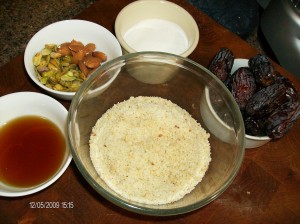
The pistachios were ground prior to the start of this recipe with the almonds bought pre-ground as well as plain bread crumbs.   ingredients

This picture shows the Khushkananaj bread crumbs prior to the whole grain bread crumbs being added.  (The picture doesn’t show ALL the dates necessary, just about a cups worth.)

I combined the dry ingredients (excluding the very sticky dates) in a large bowl.

breadcrubms w sugar pistachios

Now I had some of the almond/pistachio/spice mix left over from making Khushkananaj cookies which adds a little extra flavor to the mix.  I don’t believe that any period cook would have wasted sugar and spices by throwing out the left overs.  The left overs would have simply been incorporated into another recipe or used to experiment with.

The dates and dry ingredients were mixed together then sesame oil stirred in as needed.  The mixture was a little dry still so a extra ground up dates were added.

mixture

Here is the incorporated chopped dates and sesame oil mixed with the dry ingredients.

Once the everything has achieved a squishy consistency of well mixed ingredients, start forming balls about an inch across by rolling the dough in your hands.  If there is enough ground dates and sesame oil there should be no trouble forming balls; however if the balls start to crumble instead of compact add more dates.  The dates are sort of like the glue that binds a sweet sticky edible glue that is!

date balls

Here are a few formed ones.  Now the shape suggested is more oblong then round however the shape was very unappealing so I stuck with the ball form instead of an oblong look.

I also changed dusting with sugar to incorporating sugar into the recipe.  Dusting with sugar did two things.  The first is that the mixture is sweetened even more then just sweetness of dates.  The second is that a dusting of sugar helps to keep the date balls from sticking together.  I have found that when stored on wax paper and with the inclusion of a few extra ground nuts that sticking is not an issue.  Dust away if that is preferred though as seen dusting is not an absolute.  Time for me to go and nosh on a few of my own now!

Now this dish is a wonderful little piece.  The meat can be used on it’s own as a main dish or as a side dish to be scooped up with bread , added to the center of couscous or rice.  This also makes excellent sandwiches the day of being made or the next day when it’s a grab anything you can find to eat, stuff it into bread and go!

Bazmaward

Meat with Sour Fruit and Mint in Bread

Translation:

Take nice well done roast meat, as much as necessary, from the ribs and other parts, and pound it fine with the cleaver.  Throw fresh mint leaves on it and, if you want, a little celery leaf.  Sprinkle it with a little vinegar and lemon juice; and if you wish , put in the juice of salted lemons or of sour fruits instead of lemon juice; they are pounded with it (the meat).  Flavour it with a little milled mastic and Chinese cinnamon and sprinkle it with good rose-water.  Pound it exceedingly well until it becomes fine.  Then take some brick oven bread, watched over as it baked in the oven and let it be in the shape of a tulma loaf, (flatbread baked in the tannur oven…a round or oblong bread with a raised rim, lice Central Asian nan.)  …It should be well cooked, between dry and soft….Set it aside, then split it with the knife and stuff it well with the prepared roast, and cut it into thin pieces and arrange it in baking trays.  Throw mint leaves on it.  It is eaten right away and the following day.

(Arabic Cookery. Rodinson, pp. 382.)

Ingredients:

2.5 lbs lamb (beef or venison)               2 Tbs olive oil

(Spice rub, 1 tsp in any combination coriander, cumin, cinnamon, black caraway seeds, cayenne pepper, thyme)

To be added after cooking:

1 finely chopped salted lemon   2 Tbs mint (dried)         2 tsp pomegranate juice

1 Tbs vinegar             ¼ tsp rose-water          1 tsp cinnamon

My Redaction:

The recipe calls for rib meat as a preference as this meat is fatty.  A good substitute would be a brisket type of meat if rib meat is not available.  I originally used 2.5 lbs of leg of lamb, which means the meat was a little dryer then would be preferred.  (The second and third time I used this recipe I incorporated beef roasts.)

Spices

The lamb was cut into scallops the size of the palm of my hand and placed into a casserole dish which had been coated with olive oil and a little of the spice rub.  The meat was then layered with spicing between each layer and a final dusting of spice on the top of the meat.

Sprinkling of meat

The meat is layered with spices another layer of meat then more spices until the meat and spices fill up the baking dish or you run out of meat.

You don’t hear this often in cooking but for many period Middle Eastern cooking, lean meat is not as good as a rich fatty pieces of meat, especially for this recipe.  A little bit of sesame oil, olive oil etc would be an excellent addition to the cooking if only lean meat is available.

Once cooked the meat was allowed to cool before I chopped into small pieces.  I probably did not chop the meat as fine as the original notations indicate; however I think the sizing was suitable for sandwich stuffing and finger food.

shredded w spices

After the meat was sliced I then added the remaining ingredients to the meat, mixing well.  When the meat and spices were completely mixed, pita bread (nan can be used) was split in half and stuffed.

sandwich

A tasty treat or main meal.

When they say salty buns they weren’t kidding.  Though I did use a bit more salt then might have been necessary; the buns do make a very salty base for sweet.  I also liked the bread as a sandwich type of bun.  Good for grilled meats or the sweet and sour meats as a next day treat on salty bread.

Aqras Mumallaha

(Salted Buns)

Translation:

Take as much flour as needed and put a quarter pound of sesame oil on every pound of flour, and put in a moderate amount of salt, such that it is neither apparent nor deficient.  Bake it, after it rises, in the same way as khubz al-abazir, but (rolled) a little thinner, and when it browns lightly, take it out.  This is only made so that the appetite may incline to the salty taste, rather than the sweet, so it is served among the sweet dishes.

(Rodinson, pp. 431)

Ingredients:

2 C. flour          3 Tbs sesame oil           1 tsp salt           ¼ C water        1 tsp yeast

My Redaction:

I took 2 cups of flour and salt, combining till well blended.  The sesame oil was then added along with the water and yeast.  The yeast I placed into the water until mixed and allowed to set for 5 minutes.

dough

The recipe does not specifically say to add yeast; however with the phrase “…after it rises” makes me believe that yeast was added.  Very few kitchens have enough yeast floating through the air to make bread rise with out the addition of yeast cells.  So with that in mind I took in the need for water and yeast (technically yeast can be added with out water; however I find that with out water added with the yeast the bread is less elastic with less rise).  The dough sat until doubled in size, then formed into roughly hand sized buns and cooked at 350 till lightly brown.

HPIM1241

The dough sat rising for about an hour (you can leave bread to rise for a long while so if you forget and come back to really puffy dough…don’t panic.  The dough is still usable!).  Now you can form more then 3 out of the dough if rolled a little thinner and smaller.

If these are to be used for a dessert I would definitely suggest a smaller bun about 1-2 inches across more like a bread spoon instead of a bread pocket.

These 3 dough pieces made for very nicely formed salted buns.  Just the right size for sandwiches.

Sandwich

This is what the bread looks like stuffed with a very tasty bit of beef cut up into pieces.  The salted buns are definitly a switch hitter.  Good for both the meat and the sweet!

This bread was to be used a salty offset for the sweet dishes.  I have also used this recipe with a little less salt as a base for bread buns used for stuffing of meat into.  Very tasty and very salty.  Goes well with jams.

Khushkananaj

(Persian Dry Bread)

Translation:

Take excellent flour and put three ounces of fresh sesame oil on a pound of it.  Knead it hard with a little water.  Make it right away, with out leavening.  Then make it into long cakes and put finely pounded sugar and almonds in them, as much as they will bear; and let the sugar, like the almonds be spiced.  Sprinkle a little rose-water on them, then bake them in a tannur as bread is baked until done.  Take them up.  If you want fried, knead the dough with sesame oil and fill it and fry it and dip it in syrup and sprinkle it with sugar.

(Rodinson, pp. 425)

Ingredients:

Crust – 1.5 C flour        3 Tbs sesame oil           2 Tbs water

Filling – ¼ C almonds   ¼ C sugar

½  tsp each of ground cinnamon, cardamom, cloves, pepper

Sprinkling of rose-water

Syrup – honey or date syrup

My redaction:

My first time through on the recipe I just made the dough.  I did not do any stuffing or dipping into syrup.    I took 1.5 cups of flour and mixed with 3 Tbs of sesame oil, incorporating just enough water to form a sold but pliable dough.  I then made 2 oblong flat loaves to be cooked at 350 in the oven till golden brown.  flat bread made by dough

This dough is tasty though a lot like a pie crust dough just made with sesame oil instead of shorting.  The bread crumbs from this are AWESOME for use in anything.  We’ll refer back to this for bread crumbs at another time.

For the actual dough into stuffed cookies, I  rolled the dough on a floured surface to about ¼ inch thick (like pie dough) and cut into strips.

dough stripsThe dough strip to the left has incorporated a bit of cinnamon, which is nothing to worry about in the fundamental taste.  So if a little spicing gets incorporated into the dough…don’t worry, it’ll still be a very very tasty cookie.

The strips I rolled a little thinner and trimmed off any excess along the edges to give a more uniform and rectangular appearance.

rolled out dough

In the center of each I sprinkled the sugar, almonds and spices (mixed together in a bowl first) till there was no more room.

stuffed dough

I then folded over the edges and pressed to form a seal.

folded stuffed dough

The recipe leaves out a step and that is to seal the edges with water or egg.  The first time I did neither and there are gaps in the cooked cookies to prove it.  So with a little water on the finger tip, go along the inside of the dough before sealing, flip the edge over and press down.  The cookie is then sealed and there should be no leakage or unsightly gap showing the slip…err filling of the cookie.

Each rectangle was sprinkled with a little rose-water.  Just enough for flavor not enough to overwhelm.  The rectangles were then cooked at 350 for roughly 10 minutes or until just golden brown.  These are very dry; however with the addition of honey (or date syrup) the filled cookies become very very tasty treats.

cooked rolls and cookies

I had enough dough to make a few cookies.  They are VERY dry until you add some thing over them like honey or date syrup.  You can even make a honey rose-water syrup for dipping.  If you like dry cookies these are your new best friend, if you like things dipped into a syrup these will definitly be your new favorite.  Either way dry or with a sweet syrup you can’t go wrong serving these at your next period Middle Eastern Banquet.